

Jiangnan Art Tea
Organic 2016 Aged Wild First Spring Harvest Yuye Fish Leaf Fuding Taimu Mountain White Tea
Organic 2016 Aged Wild First Spring Harvest Yuye Fish Leaf Fuding Taimu Mountain White Tea
Impossibile caricare la disponibilità di ritiro
What's Yuye White Tea?
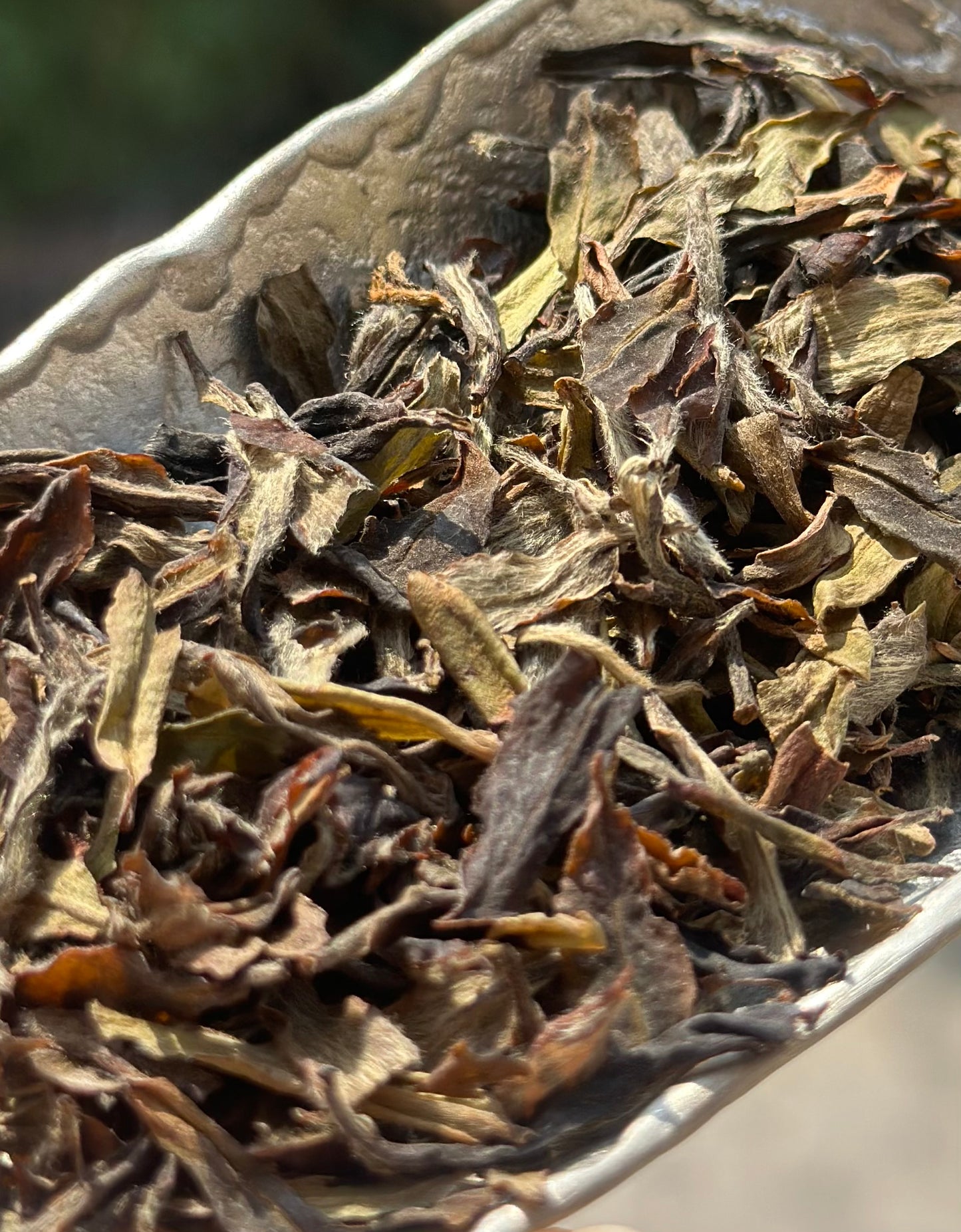
Fish leaf, the first leaf to sprout from the new shoot of the tea plant. Compared to common tea leaves, fish leaf is smaller and more delicate.
Its color is usually lighter, mostly yellowish-green, and its texture is relatively hard and brittle. Its unique shape, generally obovate, with entire edges and no serrations, is why it is named "fish leaf."

Where is this Yuye from?
This organic White Tea is from Taimu Mounta of Fuding city, which is recognized as one of the best places for the tea tree grow.
Firstly, Mount Taimu has extensive exposed granite formations, with soil growing in the crevices of the rocks. Many arborescent and wild tea trees thrive in the soil surrounding these rocks. This unique geological structure provides a distinctive growing environment for tea trees. The following are the effects of different micro-environments of Mount Taimu on tea trees under various conditions:

- Soil Conditions: The soil of Mount Taimu is rich in minerals and trace elements, and its loose, porous, and well-aerated texture is conducive to the growth of tea tree roots and nutrient absorption. Furthermore, the soil of Mount Taimu is rich in gravel, which helps tea trees absorb organic matter and minerals, resulting in a full and rich internal substance.
- Climate Conditions
The climate of Mount Taimu is also very suitable for tea tree growth. Located at 27°N latitude, Mount Taimu enjoys a warm and humid subtropical maritime monsoon climate, providing ample rainfall for tea trees that prefer shade and are sensitive to dampness. The moderate altitude of Mount Taimu ensures that ultraviolet radiation is kept within a reasonable range, and the abundant cloud cover allows for sufficient diffuse reflection of sunlight, providing ample light for the tea trees while preventing direct sunlight from damaging the tea leaves.3. Ecological Environment
The ecological environment of Mount Taimu also has a positive impact on tea tree growth. The air in Mount Taimu is rich in negative ions, which helps improve the photosynthetic efficiency of tea trees, thereby improving tea quality. Furthermore, the rich biodiversity of Mount Taimu provides abundant food sources for tea trees, contributing to their healthy growth.In summary, the granite landform of Mount Taimu provides unique soil, climatic, and ecological conditions for tea tree growth.


Production time: 2016
Origin: Maimu Mountain, Fuding city, Fujian Province, China
Tea Shape: Dry tea leaves: yellowish-brown green

Tea Soup: Clear, bright yellow

Taste Features: This precious Yuye white tea exudes a very delicious cocoa-like aroma, plus ripe and sweet fruity fragrance, mild woody aroma, sweet rose and lily of valley floral fragrance etc., After 10 years of aging, this white tea still remains a refined flowerish grapefruit scent. It tastes very mellow, flavored, and round with a lingering taste. A refined powdery floral note emerges, with a gentle sweetness and a silky texture, creating an elegant and graceful aroma profile.
The flavor is very distinctive and intense with a rich and silk-like texture.
Storage: Stored in cool, dry condition away from direct sunlight, with no odor, storage environment temperature below 30℃ (86℉)
White tea health benefits:
1. Anti-aging and antioxidant
2. Helps with sleep and eliminates fatigue
3. Has the effects of lowering blood lipids, blood pressure, and blood sugar
4. Helps improve cardiovascular health and reduce the risk of heart disease and stroke
5. Protects nerves, calms, protects the liver, and resists viruses
6. Helps promote metabolism
7. Helps improve the symptoms of respiratory diseases
8. Rich in vitamin C and vitamin E, helps with beauty and skin care
Brewing suggestions:
Tea to water ratio 1:30
Water temperature: 100℃212℉)
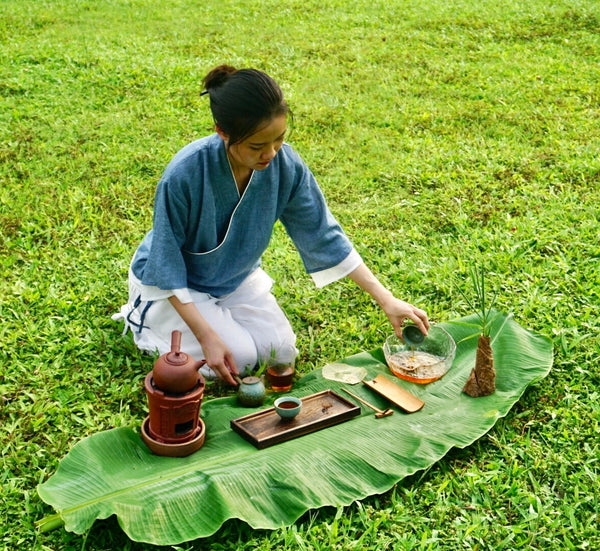
Recommended utensils: Gaiwan/Purple clay teapot
First to fourth brewing: use 100°C water (212℉), pour water along the wall of the Gaiwan at fixed points, first infusion should be longer over 30s because it’s compressed tea ,which needs more time to let tea leaves stretch in water. The late infusion can be brewed 10-15 seconds.
After the fourth brewing, use 100°C water (212℉), pour water along the wall of the Gaiwan at fixed points, wait more than 15 seconds, and then pour out the tea soup.
After several brewings, you can remove the tea from the teapot and boil it again in a kettle. Please remember to pour hot water, not cold water, into the kettle to boil the used tea. You will see that the tea is fragrant and even sweeter than when brewed in a teapot.